Professor’s Contributions to Students and Education Earn Him Award from Society for Neuroscience
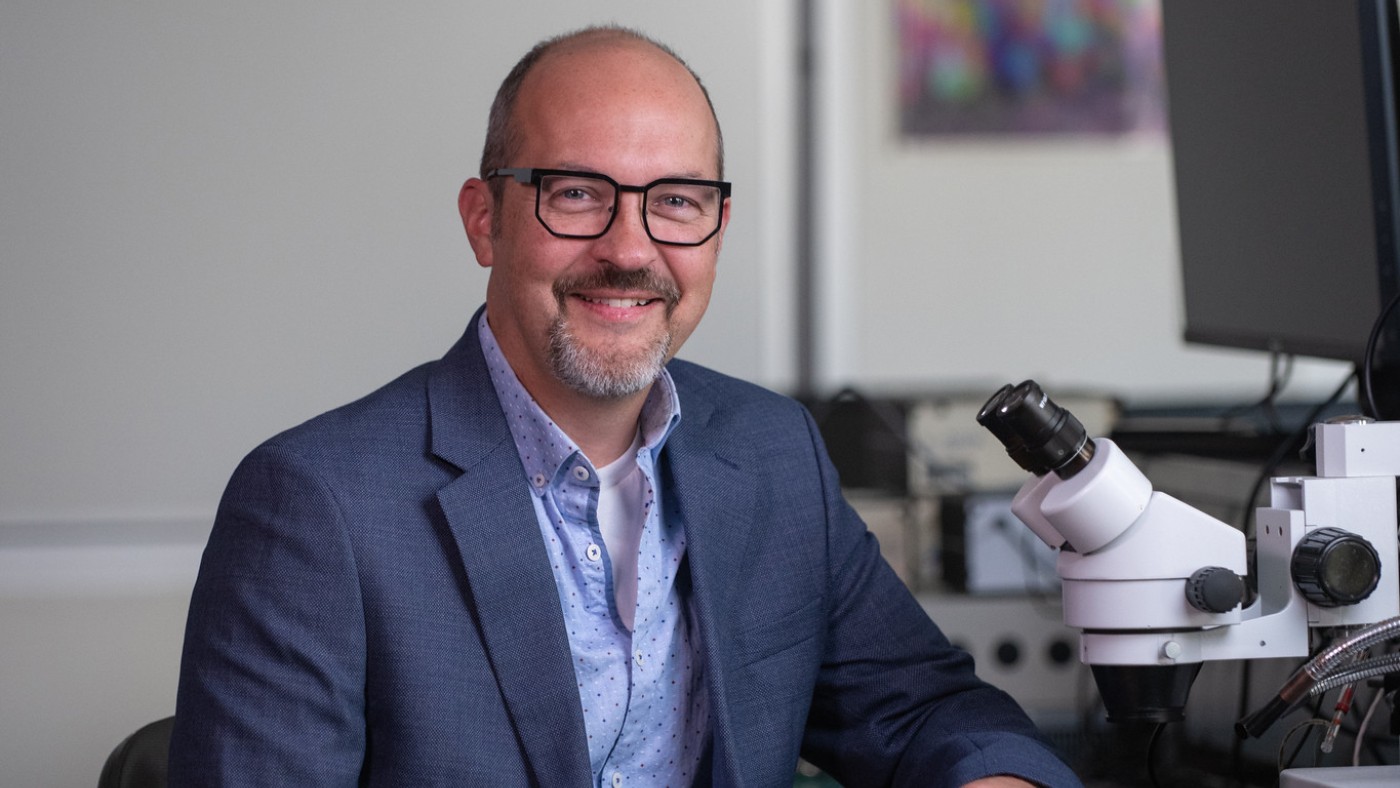
Dr. Robert Calin-Jageman, professor of psychology and director of DU's neuroscience program, has earned commendation from the Society for Neuroscience, a worldwide organization dedicated to advancing breakthrough discoveries and promoting scientific advancements.
Calin-Jageman is the recipient of the 2026 Award for Education in Neuroscience, which recognizes outstanding contributions to neuroscience education and training. He will formally receive the award during the Society for Neuroscience’s annual meeting, taking place Nov. 14-16 in Washington, D.C.
The award applauds Calin-Jageman for supporting student success, advancing inclusive education, impactful leadership, developing resources that aid educators and researchers, advocating for science, and mentoring undergraduate researchers, many of whom represent populations that are underrepresented in STEM fields.
“It is hard for me to imagine that anyone could be more worthy of SfN’s Award for Education in Neuroscience,” wrote Dr. Richard F. Olivo, professor emeritus of biology and neuroscience at Smith College, in his nomination of Calin-Jageman for this year’s honor. Olivo called Calin-Jageman a “leading spokesman for the neuroscience community to conduct rigorous and reproducible research.”
Known to his students as “Dr. Bob,” Calin-Jageman founded Dominican’s neuroscience program in 2008, introducing students to real-world, hands-on research of the brain and behavior.
“I’m proud of the way students have found success in this program,” he said. “Those who have wanted to try something kind of different have found a place in it and are able to thrive. I have seen graduates do amazing things, becoming doctors, researchers, veterinarians, pharmacists. It’s been a real source of satisfaction seeing students in the neuroscience program do so much.”
Since 2010, he and his wife, Biology Professor Dr. Irina Calin-Jageman, have led student research on memory using sea slugs in the university’s Behavioral Neuroscience Lab, more commonly known as the Slug Lab. Students are trained in independent research, problem-solving, data analysis, reaching scientific conclusions and publishing their research in scientific journals. They are also unlocking new and exciting findings in how memories are formed and forgotten.
“The Slug Lab gives students the chance to do science in ways that will lift them up and make them see what they are capable of,” Calin-Jageman noted.
Calin-Jageman’s students have won awards for their work in the Chicago Society for Neuroscience’s annual competition, and they are regular participants in annual Society of Neuroscience meetings, presenting their research and learning from professionals in various fields.
Understanding the importance of reliable data in research, Calin-Jageman developed software that aids researchers in analyzing data by highlighting margins of error to better ensure their results are trustworthy. The software makes a real difference in how researchers use data and make decisions based on it, he explained.
Calin-Jageman has co-authored numerous scientific research articles, including several with undergraduate students. He is also the leader of organizations like Faculty for Undergraduate Neuroscience (FUN) and Nu Rho Psi, the undergraduate neuroscience honor society.
“Science education and science literacy play a big role in creating a more just and humane world,” Calin-Jageman said. “Historically, science and decision-making systems have excluded many people, so having our neuroscience program be accessible and inclusive helps more students develop stronger skills and a background in science. This will empower them in their research and decision-making in ways that will benefit our society overall.”